
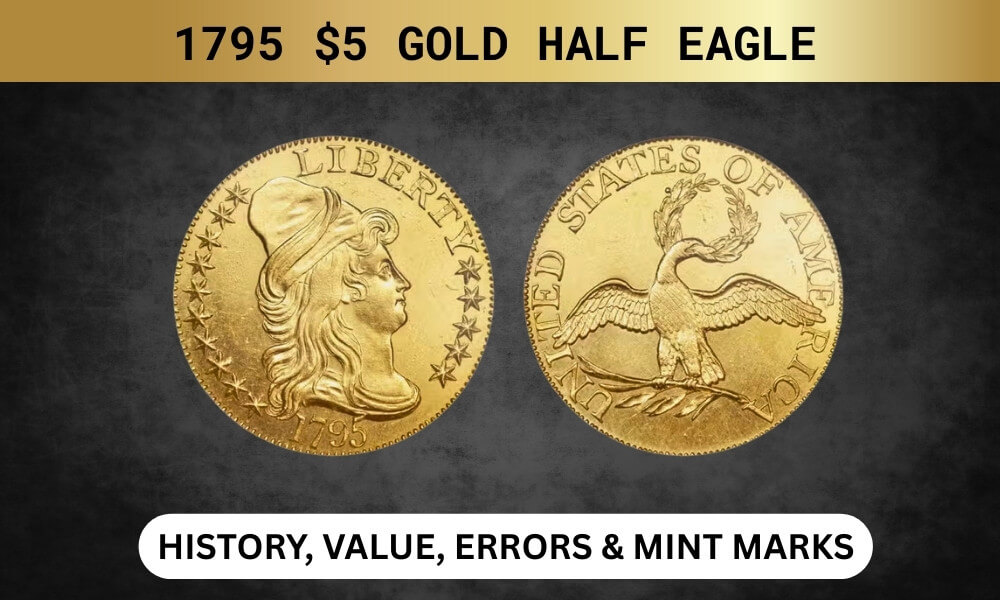
The leather-bound journal of Henry William de Saussure, second Director of the United States Mint, reveals a telling entry from July 1795: “Today we struck the first gold eagles and half eagles of our Republic. The moment was solemn, as if we were establishing not just coins but the very credibility of our young nation.”
Indeed, when the first $5 Half Eagles emerged from the Philadelphia Mint that summer, they represented far more than mere currency—they were tangible symbols of American sovereignty in a world dominated by European powers. Each coin contained the ambitions of a fragile democracy determined to prove it belonged on the world stage.
Specifications
The 1795 Half Eagle represented the pinnacle of early American minting capability, though produced under remarkably primitive conditions by modern standards.
Weight: 8.75 grams (135 grains)
Composition: 91.67% gold, 8.33% silver and copper alloy (.9167 fine)
Diameter: 25mm (approximately)
Edge: Reeded
Designer: Robert Scot, Chief Engraver
Thickness: 1.3-1.5mm
The coin’s gold content equates to 0.2579 troy ounces of pure gold. This early gold coinage used the relatively soft 22-karat standard (similar to British guineas), making the coins particularly susceptible to wear in circulation. For modern collectors, this composition presents unique handling considerations—even natural skin oils can potentially damage high-grade specimens, making cotton gloves essential when handling uncirculated examples.
Mintage & Mint Marks
The 1795 Half Eagle represents the very first year of gold coinage in United States history, with production occurring exclusively at the Philadelphia Mint (no mint mark). Records indicate a total mintage of 8,707 pieces. However, this figure is somewhat misleading as it likely includes coins struck with both 1795 and 1796 dates.
The $5 Half Eagle series from this period features several distinct varieties based on differing obverse and reverse designs. Among the 1795 issues, there are two major varieties:
- Small Eagle Reverse (BD-1 through BD-6): Approximately 8,000 struck
- Heraldic Eagle Reverse (BD-7 through BD-10): Approximately 700 struck
The Small Eagle reverse is the original design as intended for the first year of issue. The Heraldic Eagle reverse was introduced later and represents a much scarcer variety, particularly desirable among serious collectors.
Grading Standards & Diagnostic Traits
The 1795 Half Eagle presents unique grading challenges due to its soft gold composition, primitive production methods, and more than two centuries of potential wear. Understanding these grade-specific traits is essential for accurate assessment:
AG-3 to G-4: In these lower grades, the date may be barely visible, with Liberty’s profile reduced to an outline. The eagle on the reverse typically appears as a faint shape with minimal detail.
VG-8 to VF-20: Liberty’s portrait shows considerable flattening but remains outlined. Some hair details emerge at VF. The eagle shows basic wing definition but little feather detail.
EF-40 to AU-50: Major portrait features are distinct with moderate wear on high points. Liberty’s hair curls show individual strand definition. Check the high points of the cheek and hair above Liberty’s forehead, as these areas wear first. On the reverse, the eagle’s feathers show partial detail.
MS-60 to MS-63: Complete design elements with minimal wear but may display moderate contact marks, scattered bag marks, and imperfect luster. The fields should show mint luster but may have numerous small contact marks.
MS-64 to MS-65: Sharp strikes with strong luster and only minor imperfections. Few examples exist in these grades. Look for strong luster in protected areas around stars and lettering.
MS-66 and above: Virtually perfect with exceptional eye appeal. Extraordinarily rare, with perhaps 2-3 known specimens approaching this quality.
The quality of strike varies considerably on 1795 Half Eagles due to primitive minting techniques. Adjustment marks (file marks created at the Mint to correct weight) are common and not considered damage, though they do affect eye appeal.
Value by Grade
| Grade | Small Eagle Reverse | Heraldic Eagle Reverse |
| VF-20 | $40,000 – $55,000 | $85,000 – $110,000 |
| EF-40 | $65,000 – $75,000 | $135,000 – $175,000 |
| AU-50 | $100,000 – $120,000 | $175,000 – $225,000 |
| AU-58 | $150,000 – $175,000 | $225,000 – $300,000 |
| MS-60 | $200,000 – $250,000 | $325,000 – $400,000 |
| MS-62 | $350,000 – $425,000 | $525,000 – $625,000 |
| MS-63 | $500,000 – $600,000 | $750,000+ |
| MS-64+ | $800,000+ | $1,200,000+ |
Values based on recent PCGS and Heritage Auctions data as of early 2024
Notable recent transactions include a BD-3 (Small Eagle) in MS-65+ that sold for $978,000 at Heritage Auctions in January 2022, and a BD-7 (Heraldic Eagle) in MS-64 that realized $1,380,000 at Stack’s Bowers in March 2021.
Varieties & Errors
The 1795 Half Eagle varieties are cataloged using the Bass-Dannreuther (BD) numbering system, which has largely replaced the older Breen-Gillio (BG) system among specialists. Major varieties include:
Small Eagle Reverse Varieties:
- BD-1 (S-1): Centered Head. Features the bust of Liberty positioned in the center of the obverse with stars evenly spaced. Identification trait: The Y in LIBERTY is positioned directly below a star.
- BD-2 (S-2): Shifted Head. Liberty’s bust is positioned slightly to the right. Identification trait: The star closest to the cap is positioned higher than the others.
- BD-3 (S-3): The “High 5” variety. The 5 in the denomination appears higher than normal. Identification trait: The 5 is noticeably higher than the D in UNITED.
- BD-4 (S-4): Damaged Die variety. Shows a prominent die crack through Liberty’s cap. Identification trait: Visible die crack running from the rim through the cap.
- BD-5 (S-5): Small Eagle, 13 Leaves. Identification trait: Count the leaves in the olive branch—exactly 13 present.
- BD-6 (S-6): “Double Leaf” variety. Identification trait: An extra leaf appears at the junction of two normal leaves on the olive branch.
Heraldic Eagle Reverse Varieties:
- BD-7 (S-7): First Heraldic Eagle variety. Identification trait: Small letters in UNITED STATES OF AMERICA.
- BD-8 (S-8): Large Letter Edge. Identification trait: Larger lettering on the edge device and slightly larger stars on obverse.
- BD-9 (S-9): Recut Star variety. Identification trait: The star nearest Liberty’s cap shows clear recutting under magnification.
- BD-10 (S-10): The rarest variety. Identification trait: Die crack through UNITED and distinctive positioning of the stars.
The BD-3 (“High 5”) and BD-7 (First Heraldic Eagle) varieties command the strongest premiums, often trading at 15-30% above common variety prices in equivalent grades.
Authentication & Counterfeit Detection
The 1795 Half Eagle’s extraordinary value makes it a prime target for counterfeiters. Collectors should be vigilant for these authentication indicators:
Weight and Dimensions: Genuine coins weigh precisely 8.75 grams with minimal deviation. Modern counterfeits often use correct gold content but may be slightly off in weight or diameter.
Edge Reeding: Authentic specimens have approximately 90-95 reeds, applied using a Castaing machine before striking. Counterfeit detection technique: Count the reeds and compare to known genuine examples—most counterfeits have either too many or too few reeds.
Die Characteristics: All genuine 1795 Half Eagles were struck from a limited number of die pairs, each with documented characteristics. Verification method: Match your specimen to known die pairs using high-quality reference images or guides.
Surface Texture: Period-correct coins have a distinctive “fabric” to their surfaces. Modern counterfeits often show casting pits or unusual flow lines not consistent with 18th-century striking methods.
Sound Test: Genuine gold coins produce a distinctive high-pitched ring when tapped (though this test is not recommended due to damage risk).
Specific Red Flags:
- Mushy or indistinct details in the stars or lettering
- Perfect centering (genuine coins often show some striking irregularity)
- Unnaturally sharp rims or edges
- Modern-looking portrait details that lack period-correct style
For valuable specimens, professional authentication by PCGS, NGC, or CAC is practically mandatory in today’s market.
Preservation Tips
Proper preservation of 1795 Half Eagles requires extra care due to their gold composition and immense value:
Handling Protocol:
- Always use cotton, powder-free nitrile, or similar gloves when handling
- Hold coins only by their edges, never touching the fields or devices
- Work over a soft surface to prevent damage if dropped
Storage Requirements:
- Inert holders are essential; use only holders specifically designed for gold coins
- For raw (uncertified) coins, avoid PVC-containing flips or holders, which can cause long-term damage
- Professional third-party grading service holders provide excellent long-term protection
- For valuable specimens, consider PCGS or NGC holders with special inert gas filling
Environmental Controls:
- Maintain consistent humidity below 50%
- Avoid temperature fluctuations that can cause condensation
- Store away from chemicals, including household cleaners and wood products
Cleaning Warning: Never clean these coins under any circumstances. Even light brushing can remove original surfaces worth tens of thousands of dollars. Cleaning a choice uncirculated specimen could reduce its value by 50% or more.
Notable Auction Results
The most exceptional 1795 Half Eagles have achieved remarkable prices at auction:
- 1795 BD-3 Small Eagle, MS-66+ (PCGS)
- Price Realized: $1,950,000
- Auction: Legend Rare Coin Auctions, December 2020
- Note: From the D. Brent Pogue Collection, one of the finest known examples
- 1795 BD-7 Heraldic Eagle, MS-65 (NGC)
- Price Realized: $1,380,000
- Auction: Stack’s Bowers, March 2021
- Note: Ex: Bass Collection, finest known of the variety
- 1795 BD-4 Small Eagle, MS-64 (PCGS)
- Price Realized: $558,125
- Auction: Heritage Auctions, January 2019
- Note: Featured exceptional original surfaces with strong mint luster
- 1795 BD-1 Small Eagle, AU-58 (NGC)
- Price Realized: $329,000
- Auction: Stack’s Bowers, August 2022
- Note: Exceptional strike quality for the variety
- 1795 BD-10 Heraldic Eagle, AU-55 (PCGS)
- Price Realized: $376,000
- Auction: Heritage Auctions, April 2021
- Note: Rarest variety of the year with fewer than 20 known examples
These results demonstrate the exceptional premium placed on high-grade examples and rare varieties, particularly those with established pedigrees or exceptional eye appeal.
Collector Value & Outlook
The 1795 Half Eagle occupies a unique position in American numismatics that virtually guarantees its continued ascent in value and desirability.
Historical Significance: As America’s first gold coinage, these coins represent a tangible connection to the founding era. This historical importance transcends numismatics, attracting wealthy history enthusiasts and institutional collectors.
Supply Constraints: Of the original 8,707 mintage, fewer than 400 examples are believed to exist across all varieties and grades. Each passing decade sees specimens permanently entering institutional collections at the Smithsonian, American Numismatic Society, and major university collections.
Market Trends: Over the past 30 years, high-grade 1795 Half Eagles have appreciated at an average annual rate of approximately 8-12%, outperforming many traditional investments. Even during economic downturns, these coins have maintained their value exceptionally well.
Acquisition Strategy: For collectors entering this market, consider these approaches:
- Start with an accurately graded VF or EF example of the Small Eagle variety
- Focus on original surfaces rather than higher technical grade
- Prioritize specimens with established provenance
- Be patient—rushing acquisitions in this market segment typically leads to overpaying
Investment Outlook: With increased global wealth and growing interest in “trophy assets,” the finest 1795 Half Eagles will likely continue appreciating at premium rates, particularly specimens with exceptional pedigrees or unusual characteristics.
Frequently Asked Questions
How many die varieties exist for the 1795 Half Eagle?
Ten distinct die varieties are recognized in the Bass-Dannreuther reference, designated BD-1 through BD-10. Six varieties feature the Small Eagle reverse, while four display the Heraldic Eagle design.
How can I tell if my 1795 Half Eagle is genuine without professional grading?
Without professional authentication, examine these key points: correct weight (8.75 grams), proper edge reeding (90-95 reeds), die characteristics matching known varieties, and natural color consistent with 22-karat gold that has aged naturally. However, given these coins’ value, professional authentication is strongly recommended.
Why do some 1795 Half Eagles show adjustment marks, and do they affect value?
Adjustment marks were file marks made at the Mint to correct planchet weight before striking. They’re evidence of authentic production methods rather than damage. While they technically don’t reduce a coin’s grade, they do affect eye appeal and thus can impact market value by 10-30% depending on severity.
Is it better to buy a higher-grade common variety or a lower-grade rare variety?
For most serious collectors, a choice EF or AU example of a rarer variety (like BD-7 or BD-10) typically offers better long-term value than a comparably priced common variety in slightly higher grade. However, the absolute finest examples of any variety will always command extraordinary premiums.
How does the 1795 Half Eagle compare to other first-year U.S. gold issues in terms of rarity and value?
The 1795 Half Eagle is considerably more available than its larger sibling, the 1795 Eagle ($10), which had a mintage of just 5,583 pieces. It’s also generally more affordable than the 1796 Quarter Eagle ($2.50), which is a one-year type coin. Among first-year U.S. gold issues, the 1795 Half Eagle represents the most “accessible” option, though still beyond the means of most collectors.