
From Jefferson’s Desk to America’s Heritage
As Thomas Jefferson gazed upon America’s first $10 gold piece in 1795, he reportedly remarked that the young republic had finally created a coin “worthy of our nation’s aspirations.” That gold Eagle—weighing heavily in both his palm and in American history—represented more than mere currency; it embodied the financial sovereignty of a nation barely out of its infancy.
Today, when a 1795 Eagle appears at auction, collectors fall silent, checkbooks emerge, and a piece of American history changes hands for sums that would astonish even the wealthy merchants who once carried these coins in leather pouches.
Specifications
The 1795 Eagle was struck in .9167 fine gold (22 karat) with a silver and copper alloy making up the remainder. Each coin weighs 17.5 grams (270 grains) and measures 33mm in diameter, substantially larger than modern gold coins. The edge features a distinctive denticulated pattern, known as “reeding,” consisting of small parallel lines along the coin’s circumference.
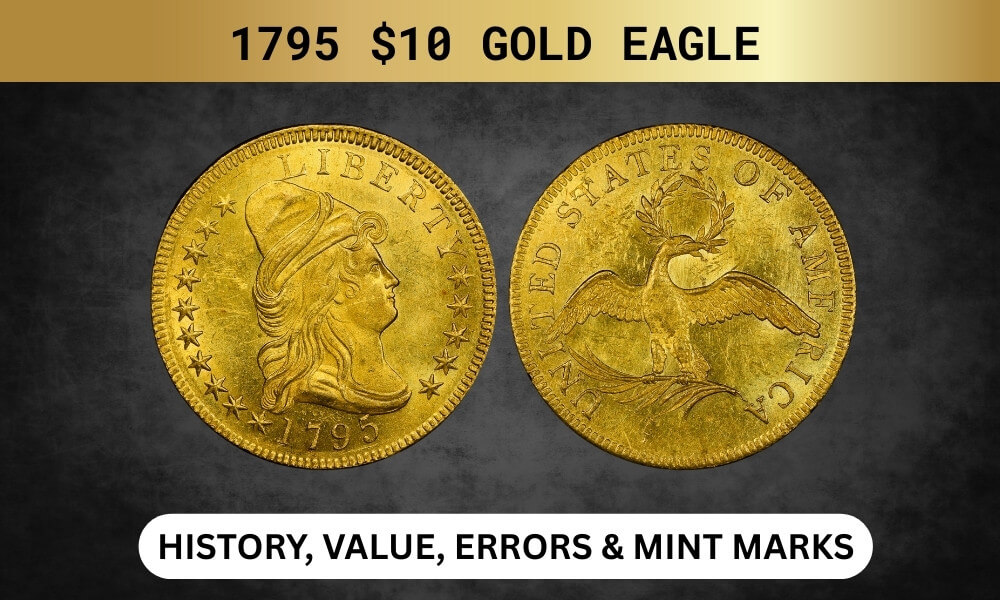
The obverse displays Liberty facing right, wearing a turban-like cap (the “Draped Bust” design by Robert Scot), while the reverse depicts an eagle with wings spread, clutching a wreath in its talons. This “Small Eagle” design would be replaced after just three years, making the 1795-1797 issues particularly desirable to collectors.
When handling these coins, collectors should always use cotton gloves, as the high gold content makes them susceptible to fingerprints and oils that can damage the surface over time. Unlike modern coins, these early Eagles were struck on planchets cut from gold sheets, resulting in slight variations in weight and thickness—a characteristic feature rather than a defect.
Mintage & Mint Mark
All 1795 Eagles were struck at the Philadelphia Mint, as it was the only operating U.S. Mint at that time. No mint marks appear on these coins. According to Mint records, 5,583 Eagles were struck bearing the 1795 date. However, numismatic research suggests that not all dies dated 1795 were used in that calendar year, and some 1795-dated coins may have been struck in early 1796.
The entire mintage was relatively small by modern standards, as the early Mint struggled with limited resources and technological constraints. Gold for these coins came primarily from foreign coins melted down for recoinage, along with some domestic gold from North Carolina deposits.
Grading Standards & Diagnostic Traits
Grading the 1795 Eagle requires considerable expertise due to its age and historical significance. Using the Sheldon Scale:
In Good (G-4) condition, major design elements remain visible but heavily worn. Liberty’s profile is flattened, with little detail in the hair or facial features. On the reverse, the eagle’s feathers are mostly worn smooth.
In Fine (F-12) condition, Liberty’s profile shows more definition, with some hair detail visible. The eagle’s wings show some feather separation, though the breast feathers remain indistinct.
In Very Fine (VF-20 to VF-35) specimens, Liberty’s hair shows clear strands, and facial details become more pronounced. The eagle displays clear wing feather definition, though highest points show wear.
In Extremely Fine (EF-40 to EF-45) examples, Liberty’s hair strands are sharp with only slight wear on the highest points. The stars surrounding Liberty retain their points, a key diagnostic for this grade. The eagle’s feathers show almost complete detail.
In About Uncirculated (AU-50 to AU-58) specimens, only the slightest friction appears on the highest design elements. Liberty’s cheek and the eagle’s breast may show minor luster breaks, while protected areas retain full mint luster.
Mint State (MS-60 and above) 1795 Eagles are exceedingly rare, with perhaps fewer than 20 examples known in true uncirculated condition. These show no wear, though they may display contact marks from handling before modern protective measures were standard.
Value by Grade
The 1795 Eagle remains one of the most valuable regular-issue U.S. coins, with even heavily worn examples commanding six-figure prices. According to recent PCGS and Heritage Auctions data:
| Grade | PCGS Price Guide Value |
| G-4 | $85,000 – $95,000 |
| VG-8 | $95,000 – $110,000 |
| F-12 | $110,000 – $125,000 |
| VF-20 | $135,000 – $150,000 |
| VF-35 | $175,000 – $200,000 |
| EF-40 | $225,000 – $250,000 |
| EF-45 | $275,000 – $325,000 |
| AU-50 | $350,000 – $400,000 |
| AU-58 | $500,000 – $600,000 |
| MS-60 | $700,000 – $800,000 |
| MS-63 | $1,000,000+ |
| MS-65+ | $5,000,000+ |
Notable recent sales include a MS-63 example that sold for $1,200,000 at Heritage Auctions in January 2023, and an exceptional MS-65+ specimen (one of just two known in this grade) that achieved $5,583,750 at a 2018 auction, the price symbolically matching the original mintage figure.
Varieties & Errors
The 1795 Eagle appears in several distinct varieties, each carrying different collector premiums:
1795 13 Leaves – The standard variety features 13 leaves in the olive branch on the reverse, symbolizing the 13 original states. This is the most commonly encountered variety.
1795 9 Leaves – This scarcer variety displays only 9 leaves in the olive branch. The easiest way to identify this variety is to count the leaves extending from the bottom of the branch, which number only three in this variety versus five in the 13 Leaves version. The 9 Leaves variety typically commands a 25-30% premium over the 13 Leaves.
1795/1795 Recut Date (BD-1) – In this variety, the date shows clear repunching, visible particularly on the “79” digits. A loupe reveals doubling at the base of these numerals. This variety carries a 10-15% premium.
1795 with Double Struck Reverse – Extremely rare, with only three known examples. These coins show evidence of a double strike on the reverse, with ghosting visible in the eagle’s wings and stars. When these appear at auction, they typically sell for more than twice the value of regular specimens in the same grade.
Authentication & Counterfeit Detection
Given their extraordinary value, 1795 Eagles are frequent targets for counterfeiters and alteration. Authentication requires multiple approaches:
Weight Testing – Genuine coins weigh 17.5 grams ±0.5 grams. Digital scales with 0.1-gram precision can detect most counterfeits.
Diameter and Thickness – The 33mm diameter should be consistent, though thickness may vary slightly due to early minting techniques.
Edge Examination – The reeded edge of genuine coins shows slight irregularities characteristic of the minting process. Under magnification, modern counterfeits often display too-perfect reeding.
Die Characteristics – All genuine 1795 Eagles were struck from a limited number of die pairs that have been extensively studied. Key diagnostic points include:
- The positioning of stars relative to Liberty’s head
- The specific arrangement of denticles around the border
- The placement of the date digits beneath Liberty
Surface Texture – Genuine coins display a distinctive texture from the 18th-century minting process. Under 10x magnification, the fields should show flowlines characteristic of early Mint striking methods.
Certification – Due to the coin’s value, professional certification by PCGS, NGC, or another reputable service is essentially mandatory before purchase. Even experienced collectors rarely buy uncertified 1795 Eagles.
Preservation Tips
Preserving a 1795 Eagle requires special consideration given its gold content and historical significance:
Store the coin in an inert holder that contains no PVC or other harmful plastics. PCGS or NGC holders are ideal, as is Mylar for non-certified examples.
Maintain stable environmental conditions. Gold coins are less susceptible to toning than silver, but extreme humidity can eventually affect even gold surfaces.
For uncertified coins, avoid cleaning of any kind. The natural patina that develops on early gold coins is considered desirable and enhances rather than detracts from value.
When handling is necessary, use cotton gloves and hold the coin only by its edges.
For insurance purposes, document your coin with high-resolution photographs of both sides and store these images separately from the coin itself.
Consider a safety deposit box rather than home storage for a coin of this value.
Notable Auction Results
The auction history of 1795 Eagles tells a story of steadily increasing value and collector appreciation:
- In 1979, a VF-30 example sold for $28,000 at Stack’s—a princely sum at the time.
- In 1999, a MS-63 specimen realized $173,000 at Bowers & Merena Galleries.
- The Pogue Collection MS-65+ example achieved $5,583,750 in 2018, setting a record for the date.
- In 2020, a relatively modest AU-53 example sold for $408,000, demonstrating strong demand even for mid-range specimens.
- Most recently, in January 2024, a newly discovered EF-45 example sold for $305,500 at Heritage Auctions, exceeding the pre-sale estimate by nearly $50,000.
This steady appreciation reflects not only the coin’s rarity but its historical significance as America’s first gold $10 piece.
Collector Value & Outlook
The 1795 Eagle occupies a unique position in American numismatics. As both the first year of issue for the denomination and one of the earliest gold coins struck by the United States Mint, it holds tremendous historical significance beyond its intrinsic precious metal value.
For collectors, the 1795 Eagle represents the cornerstone of an early gold collection. While most collectors will never own one due to price constraints, those who acquire even a modestly graded example join an exclusive fraternity of custodians who have preserved this piece of American history across generations.
From an investment perspective, the 1795 Eagle has consistently outperformed most other numismatic investments. Analysis of auction results over the past four decades shows an average annual appreciation of approximately 8-10%, though with significant variations depending on grade and market conditions.
Market trends suggest continued strong demand, particularly as wealthy international collectors increasingly recognize the importance of early American coinage. The limited supply—with fewer than 400 examples estimated to exist across all grades—creates a natural ceiling on availability while demand continues to grow.
For the serious collector with adequate resources, a 1795 Eagle represents not only a sound acquisition but a tangible connection to the founding era of the United States. Each coin passed through hands that may have included founding fathers, early American merchants, and generations of collectors who understood its significance.
Frequently Asked Questions
How many 1795 Eagles exist today from the original mintage?
Numismatic experts estimate that approximately 350-400 examples survive across all grades. Most display significant wear, with perhaps 80% in grades below Extremely Fine. The attrition rate was high due to melting during gold recoinages and the gold recall of 1933, making even heavily worn examples highly desirable.
Should I purchase a 1795 Eagle raw or certified?
Given the exceptional value and prevalence of counterfeits, purchasing a certified example is strongly recommended. The modest premium for certification is insignificant compared to the security it provides. If considering a raw example, budget for immediate certification by a major grading service.
How does the 1795 Eagle compare in rarity to other early U.S. gold coins?
The 1795 Eagle is approximately twice as rare as the 1795 Half Eagle ($5 gold piece) but more common than the extremely rare 1796 and 1797 Eagles with the Small Eagle reverse. In the context of all early American gold, it stands among the most significant but not the absolute rarest, occupying a sweet spot of extreme historical importance and challenging but not impossible acquisition.
What is the best strategy for acquiring a 1795 Eagle?
Patient, educated pursuit yields the best results. Establish relationships with major auction houses and dealers specializing in early American gold. Set notifications for upcoming sales, and be prepared to wait for the right combination of authenticity, eye appeal, and value. Consider joining numismatic organizations like the American Numismatic Association to network with other collectors and expand your knowledge before making such a significant purchase.
Is it legal to own a 1795 Eagle despite the 1933 gold recall?
Yes, absolutely. The 1933 gold recall exempted coins of numismatic value, and all pre-1834 U.S. gold coins clearly qualify under this exemption. Ownership of 1795 Eagles is completely legal and has been continuously since their minting.
For the serious numismatist, few acquisitions can match the historical significance and collector prestige of America’s first $10 gold piece. Whether as the centerpiece of an advanced collection or a stand-alone treasure representing the birth of American coinage, the 1795 Eagle continues to captivate collectors more than two centuries after leaving the Philadelphia Mint’s coin press.